What Is DHT?
- Dihydrotestosterone (DHT)
- A potent androgen hormone converted from testosterone by the enzyme 5-alpha-reductase (5-AR). DHT is defined as the primary hormonal driver of androgenetic alopecia in genetically susceptible men. While DHT plays important roles during development (prostate growth, body hair, male sexual characteristics), in the scalp it binds to androgen receptors on hair follicles, triggering a process called follicular miniaturization.
When DHT binds to susceptible follicles — primarily at the temples, crown, and frontal hairline — it shortens the anagen (growth) phase of the hair cycle and progressively shrinks the follicle. Over multiple cycles, terminal hairs become thinner vellus hairs, and eventually the follicle can stop producing visible hair entirely. This process is gradual, which is why early intervention produces better outcomes than waiting until significant loss has occurred.
The Role of 5-Alpha-Reductase
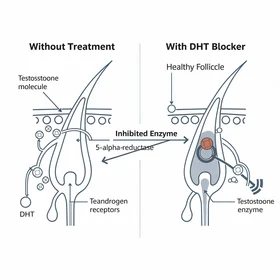
5-alpha-reductase exists in two isoforms. Type II 5-AR is the primary enzyme responsible for DHT conversion in hair follicles and the prostate. Prescription finasteride (the active ingredient in Propecia and Procerin Rx) selectively inhibits Type II 5-AR, reducing scalp DHT levels by approximately 60–70% without eliminating systemic testosterone.
The challenge with oral finasteride is systemic exposure — the drug circulates throughout the body, which is why some men experience sexual side effects (reported in 2–4% of clinical trial participants). This is the rationale behind Procerin Rx's topical delivery: applying finasteride directly to the scalp reduces systemic absorption while maintaining local efficacy at the follicle level. Published studies on topical finasteride show comparable hair count improvements to oral finasteride with a lower incidence of systemic side effects.
Procerin OTC: Natural 5-AR Inhibition
Procerin OTC takes a different approach — using plant-derived compounds that have demonstrated 5-AR inhibitory activity in laboratory and clinical studies:
Liposterolic extract inhibits both Type I and Type II 5-AR. A 2020 systematic review in Skin Appendage Disorders found saw palmetto improved hair density in 60% of participants across multiple studies, though with smaller effect sizes than finasteride.
A plant sterol structurally similar to cholesterol that competitively inhibits 5-AR. A study in The Lancet (1995) demonstrated its efficacy for BPH (benign prostatic hyperplasia), which shares the same DHT-driven mechanism as androgenetic alopecia.
Contains compounds (secoisolariciresinol, oleanolic acid) that inhibit 5-AR and block DHT binding to SHBG (sex hormone-binding globulin). Peer-reviewed evidence supports its anti-androgenic properties, primarily studied in prostate tissue.
A randomized, double-blind, placebo-controlled study published in Evidence-Based Complementary and Alternative Medicine (2014) showed 40% improvement in hair count after 24 weeks of supplementation with pumpkin seed oil.
Procerin Rx: Multi-Agent Prescription Formula
Procerin Rx combines six active ingredients in a single topical application:
- Finasteride 0.5% — 5-AR Type II inhibitor, reduces follicular DHT. Topical delivery limits systemic absorption.
- Minoxidil 8% — vasodilator that extends anagen phase and increases follicle size. Higher concentration than OTC minoxidil (typically 5%).
- Azelaic acid — mild 5-AR inhibitor with anti-inflammatory properties. May reduce scalp inflammation that accelerates miniaturization.
- Tretinoin — enhances minoxidil absorption by increasing scalp permeability. Also promotes collagen synthesis in the dermal papilla.
- Melatonin — antioxidant with demonstrated hair growth properties in pilot studies. Protects follicles from oxidative stress damage.
- Caffeine — stimulates hair matrix keratinocyte proliferation. In vitro studies show caffeine counteracts testosterone-mediated suppression of hair growth.
Cons and Considerations
Honest assessment of what the science does and doesn't support:
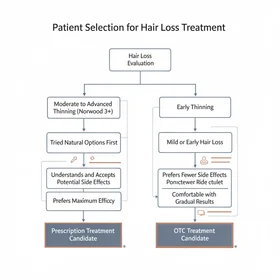
- Natural ingredients have weaker effect sizes than finasteride. Saw palmetto and beta-sitosterol show statistically significant but modest results compared to prescription 5-AR inhibitors. Men with moderate-to-advanced loss should have realistic expectations for OTC approaches.
- Individual response varies significantly. Genetics determine both DHT sensitivity and response to treatment. Some men see meaningful improvement; others see minimal change. The 90-day money-back guarantee exists for this reason.
- No treatment reverses complete follicle death. Once a follicle has fully miniaturized and scarred over, neither OTC nor prescription treatments can revive it. Only surgical transplantation moves live follicles to bald areas.
- Long-term commitment required. DHT-driven hair loss is ongoing — stopping treatment allows the process to resume. This is true of all DHT-based approaches, not just Procerin.
- Procerin Rx contains finasteride. While topical delivery reduces systemic exposure, it does not eliminate it entirely. Procerin Rx is not ideal for men with a history of adverse reactions to finasteride — consult a doctor or healthcare professional before starting any prescription hair loss treatment.