
The Hair Loss Treatment Landscape in 2026
- Androgenetic alopecia treatment
- Defined as any intervention that slows, halts, or partially reverses DHT-driven follicular miniaturization in men. Treatments range from FDA-approved pharmaceuticals to natural supplements, devices, and surgical procedures — each with different efficacy profiles, cost structures, and side effect considerations.
There is no single "best" treatment for male pattern hair loss. The right approach depends on your Norwood stage, tolerance for side effects, budget, and how aggressively you want to intervene. Here's an honest comparison of the major categories and where Procerin's two products fit within them.
Treatment Comparison
| Treatment | Efficacy | Side Effects | Cost/Month | Prescription? | Best For |
|---|---|---|---|---|---|
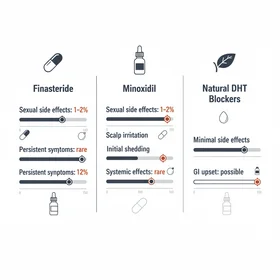
| Oral Finasteride (Propecia) | High — gold standard | Sexual side effects in 2–4% | $10–30 | Yes | Norwood II–V, men comfortable with Rx |
| Minoxidil 5% (Rogaine) | Moderate | Scalp irritation, initial shedding | $15–30 | No | Crown thinning, adjunct therapy |
| Procerin OTC | Moderate (IRB study) | None reported | $30–40 | No | Norwood I–III, natural approach |
| Procerin Rx | High (multi-agent) | Lower vs. oral finasteride | $60–80 | Yes (telemedicine) | Norwood III–V+, prescription strength |
| Laser/LLLT Devices | Low–Moderate | None significant | $0 (device: $200–700) | No | Adjunct therapy, mild thinning |
| PRP Therapy | Moderate (variable) | Injection discomfort | $200–500/session | Clinic only | Adjunct, willing to invest |
| Hair Transplant | Permanent (surgical) | Surgical recovery, scarring | $4,000–15,000 one-time | No (surgical) | Norwood IV+, stable loss pattern |
Best for Each Stage
One of the most useful frameworks for choosing a hair loss treatment is matching it to your Norwood stage — the standardized classification system dermatologists use to describe the pattern and extent of male hair loss.
Early Loss (Norwood I–II): Recession Starting
At this stage, you're noticing mild temple recession or early frontal thinning. The follicles are still largely active — they're miniaturizing but not dead. This is where conservative, low-risk approaches have the best chance of maintaining what you have.
Best options: Procerin OTC (natural, no side effects, addresses DHT systemically and topically), minoxidil 5% (stimulates growth at the crown), or a combination of both. Most dermatologists don't prescribe finasteride at this stage unless loss is progressing rapidly.
Moderate Loss (Norwood III–IV): Visible Thinning
Significant temple recession, frontal thinning, or crown thinning. The window for non-prescription approaches is narrowing — stronger intervention produces better outcomes at this stage.
Best options: Procerin Rx (topical finasteride + minoxidil 8% + adjuncts), oral finasteride, or Procerin OTC + Rx combined protocol. Consider adding LLLT as an adjunct. PRP may help if you're willing to invest in clinic visits.
Advanced Loss (Norwood V+): Extensive Baldness
Large bald areas with limited remaining hair. Many follicles have fully miniaturized. Topical and oral treatments can maintain remaining hair but have limited ability to regrow in extensively bald areas.
Best options: Hair transplant surgery (FUE or FUT) to redistribute live follicles, combined with finasteride or Procerin Rx to protect transplanted and remaining native hair. Manage expectations — no product regrows hair from dead follicles.
Alternatives to Procerin
We're a Procerin site, so take our perspective with appropriate context. Here are the direct competitors and how they differ:
- Nutrafol — Whole-body approach targeting stress, inflammation, and nutrition alongside DHT. More expensive ($79–88/month). Clinical studies show improvement but use different measurement methodologies than Procerin's IRB study. Best for men who want a comprehensive wellness supplement that includes hair loss as one benefit.
- Keeps / Hims — Telemedicine platforms offering generic finasteride and minoxidil. Lower cost for basic prescriptions ($20–35/month). The medications are the same as what's in Procerin Rx, but without the additional active ingredients (azelaic acid, melatonin, tretinoin, caffeine). Best for men who want simple, low-cost prescription access.
- Viviscal — Marine protein complex (AminoMar). Clinical data shows modest improvement in hair density. No DHT-blocking mechanism — works through nutritional support. Best for women or men whose thinning is nutrition-related rather than DHT-driven.
- Topical Dutasteride — Stronger 5-AR inhibitor than finasteride (blocks both Type I and Type II). Not FDA-approved for hair loss but prescribed off-label by some dermatologists. Potentially more effective but with a higher side effect profile.
Cons and Considerations
No treatment is perfect. Here's what the evidence shows about limitations across the board:
- All DHT treatments require ongoing use. Stop the treatment, and DHT-driven miniaturization resumes within months. This applies to finasteride, Procerin, and every other DHT-based approach. There is no "cure" for androgenetic alopecia — only ongoing management.
- Earlier is better — always. Every month of untreated DHT exposure means more follicle miniaturization. Starting at Norwood II produces dramatically better outcomes than starting at Norwood IV. If you're reading this and noticing early thinning, acting sooner gives you more to work with.
- Combination approaches outperform monotherapy. The evidence consistently shows that combining DHT blockade (oral or topical finasteride, or natural 5-AR inhibitors) with a growth stimulant (minoxidil) produces better results than either alone.
- Supplements cannot match prescription efficacy for advanced loss. Procerin OTC is transparent about this — its natural ingredients have meaningful but modest 5-AR inhibitory effects compared to pharmaceutical finasteride. That's why Procerin Rx exists as a separate product for men who need stronger intervention.
- Surgery is the only option for restoring hair to fully bald areas. No topical, oral, or laser treatment can revive a completely dormant follicle. Hair transplantation physically moves live follicles from donor areas to bald zones.