
"When will I see results?" is the first question everyone asks. The honest answer depends on your starting point, your consistency, and what you define as "results." Here is what Procerin's clinical data and 20+ years of user feedback tell us about the actual timeline.
Month 1 (Days 1-30): The Invisible Phase
You will not see any visible change in month one. This is completely normal and expected. Here is what is happening beneath the surface:
- Natural 5-AR inhibitors (saw palmetto, beta-sitosterol) are accumulating to therapeutic levels in your system
- DHT conversion is beginning to slow at the follicle level
- Hair follicles are still in whatever growth cycle phase they were in when you started
- The topical foam is establishing consistent local delivery to thinning areas
What to look for: Nothing visible. Resist the urge to evaluate. Some users notice slightly less hair on their pillow by week 3-4, but this is not universal and should not be your benchmark yet.
What NOT to do: Do not quit. Do not switch products. Do not add other treatments. Give the protocol time to establish baseline efficacy before making any changes.
Month 2-3 (Days 30-90): Reduced Shedding
This is when the first measurable signal typically appears. The clinical study data and consistent user reports both point to reduced daily hair fall as the earliest indicator of response.
of clinical study participants reported reduced hair loss in this window
hairs per day is normal shedding. A reduction below your personal baseline is the signal.
How to measure: Count hairs in your shower drain or on your pillow for 3 consecutive days at the start of month 1 and again at the start of month 3. A meaningful reduction (even 20-30% fewer) indicates the DHT-blocking mechanism is engaging.
Important context: Reduced shedding does not mean visible regrowth. It means the miniaturization process is slowing. Think of it as putting on the brakes before you can shift into reverse. This is progress, even though it does not look like progress yet.
About Initial Shedding
A small percentage of users notice a temporary increase in shedding during weeks 2-4. This is less common with natural DHT blockers than with minoxidil, but it can occur. It indicates follicles cycling from telogen (rest) to anagen (growth), pushing out old hairs to make room for new ones. If it happens, it typically resolves within 2-3 weeks. Do not stop treatment because of it.
Month 3-6 (Days 90-180): Visible Changes Begin
This is the window where comparison photos start to tell a story. What you may see:
- Thicker individual hairs: Follicles that were producing thin, miniaturized hairs begin producing thicker shafts as DHT exposure decreases
- Improved density appearance: More hairs in the active growth phase at any given time, creating a fuller look
- Fine baby hairs at the hairline edge: Vellus hairs becoming visible at the frontal margin (these may thicken over time into terminal hairs)
- Scalp less visible through hair: Particularly noticeable at the crown and midscalp
The evaluation point: Day 90 is when you should make your first formal assessment. Compare photos from day 1 to day 90 under identical lighting. If you see reduced shedding plus any of the above visible changes, continue. If you see absolutely no change in shedding or appearance after 90 days of perfect compliance, you may be a non-responder (approximately 13% of users based on the clinical study).
Month 6-12: Maximum Benefit Window
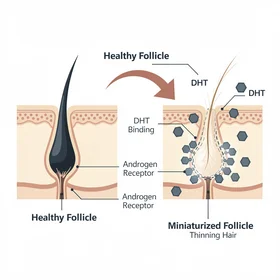
The full effect of natural DHT blocking unfolds over 6-12 months. This is because:
- The anagen (growth) phase lasts 2-6 years. New growth stimulated at month 3 needs months to reach visible length.
- Multiple follicle cycles need to pass before miniaturization reversal becomes apparent
- The cumulative effect of continuous low DHT exposure strengthens with each growth cycle
What responders typically see at month 12:
- Stable or improved hairline position (no further recession)
- Thicker overall appearance in previously thinning areas
- Hair that holds styles better due to increased shaft diameter
- Reduced contrast between thinning areas and full-density areas
After 12 months, results typically stabilize. The goal shifts from active improvement to long-term maintenance of gains.
Who Responds Best
Not everyone responds equally. Based on the clinical data and consistent user patterns:
Factors That Predict Better Results
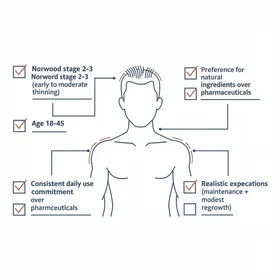
- Earlier Norwood stage: More active follicles means more follicles that can respond to DHT reduction
- Shorter duration of visible loss: Follicles that have been thinning for 1-2 years respond better than those miniaturizing for 10+ years
- Consistent daily use: The single strongest predictor. Daily compliance with both tablets and topical produces measurably better outcomes than occasional use.
- Younger age: Follicles in younger men tend to retain more recovery potential
Who Should Try Something Else

Procerin is not the right fit for everyone. Consider alternatives if:
- You are at Norwood V or higher: Advanced loss with long-established bald areas needs prescription-strength intervention or surgical restoration. Natural DHT blockers work best for preservation and early-stage reversal, not restoring extensively bald scalp.
- You need the fastest possible results: Prescription finasteride has stronger clinical evidence for rapid DHT suppression. If speed matters more than avoiding prescription side effect risk, talk to a dermatologist.
- Your hair loss is not DHT-driven: Patchy loss (alopecia areata), sudden diffuse shedding (telogen effluvium), or loss from medications requires different approaches entirely.
For independent opinions on what Procerin users actually experience over time, what users say about Procerin collects real user feedback with clinical context. And if you are considering adding other products to your stack, comparing all hair loss product types provides honest comparisons across the full treatment landscape.
The Bottom Line
Procerin works on a biological timeline, not a marketing timeline. Month 1 is invisible. Months 2-3 show reduced shedding. Months 3-6 show visible changes in responders. Months 6-12 deliver maximum benefit. After that, it is about maintenance.
The men who see results are the ones who stick with it through the invisible phase and evaluate honestly at day 90 with comparison photos, not daily mirror checks. Procerin's 90-day money-back guarantee is designed around this exact timeline.